
The short version:
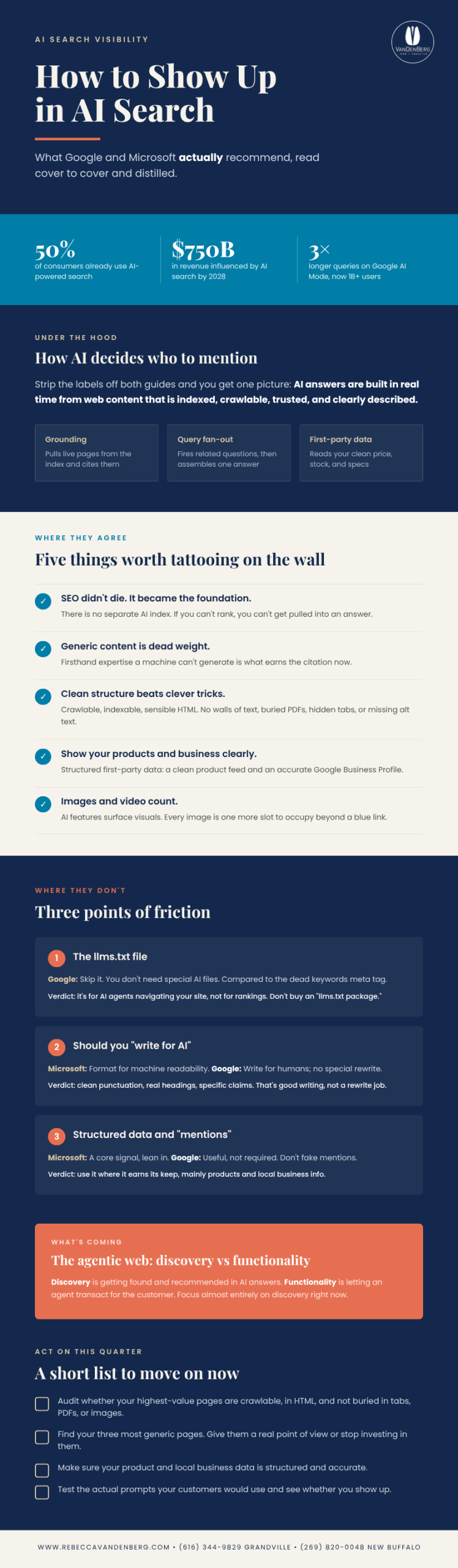
Google and Microsoft both published official guidance this year on getting found in AI search. They agree on the foundation: strong SEO, content with a real point of view, clean structure, and accurate business data. They contradict each other on two specific things, special AI files like llms.txt and whether you should rewrite content for machines. There is no shortcut file and no secret markup. The work that earns visibility in AI search is the same work that always did, done well.
The way people find businesses is changing, and most owners haven’t noticed yet.
According to McKinsey, half of consumers already use AI-powered search, and that shift stands to influence roughly $750 billion in revenue by 2028. Google has said its AI Mode passed a billion monthly users, with queries that run about three times longer than a traditional search and follow-up questions climbing every month. Your customers are asking ChatGPT, Copilot, and Google’s AI Mode the questions they used to type into a search bar. Then they act on whatever answer comes back.
So the obvious question: how do you actually show up in those answers?
This year, both Google and Microsoft answered it on the record. Google published an official best-practices guide, “Optimizing your website for generative AI features on Google Search,” last updated June 5, 2026. Microsoft published an updated edition of its AI Marketer’s Guide, “AI Search Demystified,” announced February 11, 2026 by Paul Longo, who runs AI in Ads at Microsoft Advertising.
We read both, cover to cover. One is written for website owners and SEOs. The other is written for marketers and advertisers. Where two companies with opposite incentives say the same thing, you can usually trust it. Where they split, you learn something. Here’s the breakdown.
How AI actually decides who to mention
Before the recommendations make sense, it helps to understand what’s happening under the hood. Both guides explain it, and both point to the same conclusion.
Google’s guide describes two mechanisms. The first is retrieval-augmented generation, which Google also calls grounding. When you ask an AI a question, it reaches into Google’s live search index, pulls relevant pages, and builds its answer from what it finds, with clickable links back to those sources. The second is “query fan-out.” Instead of running your one question, the model quietly fires off a batch of related questions at the same time, then assembles one answer from all of it.
Microsoft’s guide describes the same thing in three stages. First, what the model already knows about a product category from training. Second, the model pulling in indexed web content to confirm details and see how brands are described across trusted sources. Third, your own organized product data, like a feed listing each item’s current price, availability, and specs.
Strip the labels off both and you get the same picture. AI answers are built, in real time, from web content that is indexed, crawlable, trusted, and clearly described. That is the whole reason the recommendations look the way they do.
Where Google and Microsoft agree
This is the part worth tattooing on the wall, because both companies say it plainly.
SEO didn’t die. It became the foundation.
Google’s guide opens by asking whether SEO is still relevant for AI search and answers with a flat yes. Its AI features run on the same core ranking and quality systems that have always run Search. There is no separate AI index. If you can’t rank, you can’t get pulled into an AI answer.
Microsoft says the same thing from the marketing side. Its guide quotes SEO consultants Aleyda Solis and Lily Ray, who agree that the foundational practices, technical optimization, content clarity, and reputation, all carry straight over. Two companies, opposite business models, same message. Foundations first.
Generic content is dead weight.
Both guides land hard here. Google tells you to create what it calls non-commodity content. Its own example is sharp: a generic “7 Tips for First-Time Homebuyers” article is something anyone, or any AI, could produce. Compare that to a piece on why you waived a home inspection and what the sewer line inspection actually found. One restates common knowledge. The other carries real, firsthand expertise a machine can’t generate.
Microsoft makes the same case through Crystal Carter of Wix, who notes that generic explainer content used to pull traffic and now mostly gets answered by the AI before anyone reaches your site. What earns visibility now is the differentiated take, the thing that makes you the source worth citing.
Clean structure beats clever tricks.
Google asks for a clear technical structure: pages that are crawlable, content eligible to be indexed and shown with a snippet, sensible HTML, a solid experience across devices, and reduced duplicate content. None of it is exotic. None of it is new. These are the same basics that have mattered for years.
Microsoft comes at the same idea by naming the mistakes that break it. Its guide flags four things that get your content skipped by AI: long walls of text that blur your ideas together, important information trapped inside a PDF instead of on a normal web page, key answers hidden in tabs or drop-down menus that AI may never open, and details locked inside an image with no alt text (the written description that tells a machine what the image shows). Fix those four and you have done most of the work.
Show your products and your business clearly.
For online stores and local businesses, both guides point to what they call structured first-party data.
What that actually means: a clean, organized list of facts about your business that you hand the search engine directly, instead of making it dig those facts out of your pages. Two everyday examples: a product feed that lists each item with its price, whether it’s in stock, and its specs, and a Google Business Profile that holds your hours, address, phone number, and services. It’s your own information, formatted so a machine can read it without guessing.
Google points to Merchant Center feeds and an accurate Google Business Profile. Microsoft calls this the precision signals layer and points to its own catalog enrichment agent and Microsoft Merchant Center. The principle is identical: when AI recommends you, it needs your current price, availability, and specs from a clean source. Give it that source or watch it recommend the competitor whose data was easier to read.
Images and video count.
Both guides tell you to support your content with quality visuals. Google notes its AI features surface relevant images and video, which is one more slot you can occupy beyond a blue link. Microsoft’s Pedro Bojikian makes the same recommendation. Visual content is no longer a nice-to-have.
Where they don’t agree
Now the useful part. On three specific points, the two guides diverge, and one is a genuine contradiction.
1. The llms.txt question.
You may have heard you need to add an “llms.txt” file to your site so AI can read it. Google says skip it. Its guidance is blunt: you do not need special AI files, markup, or Markdown to appear in AI search. Google’s John Mueller compared llms.txt to the long-dead keywords meta tag.
Then Google’s own house started sending mixed signals. Chrome’s Lighthouse tool added an experimental check for the file even as the Search team said to ignore it. So which is it? The resolution is the framing Mueller himself used: discovery versus functionality.
Discovery vs. functionality: an llms.txt file does nothing for your rankings or your visibility in AI answers (discovery). It may help browser-based AI agents navigate your site to complete a task (functionality). Unless you run developer documentation or you are specifically preparing for AI agents to act on your site, you do not need one.
Bottom line: do not let anyone sell you an “llms.txt package” as an AI ranking fix. It is not one, and Google has said so twice.
2. Whether you should “write for AI”
This is the real disagreement, and both sides are partly right. Microsoft’s guide focuses heavily on writing and formatting your content so AI can read it cleanly. Keep punctuation simple. Go easy on em dashes. Drop decorative symbols. Use bullets for key steps. Write for intent, and add specifics instead of vague claims, so “42 dBA dishwasher designed for open-concept kitchens” instead of “quiet dishwasher.”
Google says nearly the opposite. You do not need to rewrite content in a special way just for AI. You do not need to chunk it into tiny pieces. Its systems understand synonyms and meaning on their own.
So who’s right? Both, mostly, because they’re describing the same thing from opposite ends. Clean punctuation, real headings, claims backed by specifics, no walls of text. That is not “writing for robots.” That is just good writing. Write clearly for a human and you have already done most of what Microsoft’s advice is chasing. Where they actually conflict is the framing, and on the framing Google is right: treating AI optimization as a separate rewrite job is wasted effort. Write for the person. Keep it clean and specific.
One small irony: Microsoft now officially recommends going easy on em dashes for machine readability. Some of us have been making that case for other reasons for a while.
3. How much to lean on structured data and “mentions”
Microsoft treats structured first-party data as a core signal and leans into it. Google agrees it’s useful for commerce and rich results but says it is not required for AI search, and there’s no special schema you need to add. Google also warns against chasing inauthentic “mentions” across the web to game the system, because its ranking and spam systems are built to see through that.
The reconcile is simple. Use structured data where it earns its keep, mainly products and local business info. Don’t treat it as a magic AI lever, and don’t pay anyone to manufacture fake mentions.
What’s coming: the agentic web
Both guides also look ahead to the same place, which tells you it’s not hype.
Google has a section on agentic experiences, where autonomous AI agents browse your site to complete tasks like booking or comparing specs. It points to emerging standards like the Universal Commerce Protocol. Microsoft is further down this road commercially, with Brand Agents, launched January 2026, which answer in your brand voice, and Copilot Checkout, which lets people buy without leaving the conversation.
This is where “discovery versus functionality” comes back. Discovery is getting found and recommended in AI answers. Functionality is letting an AI agent actually transact for the customer. Most businesses should focus almost entirely on discovery right now. Functionality matters if you sell online and want to be ready when agent-driven buying scales. For everyone else, it’s watch and wait.
What this actually means for your business
The work that earns visibility in AI search is the same work that earned it before, done well. A site that is technically sound and crawlable. Content with a real point of view that a machine couldn’t have written. Clean, specific writing and clear structure. Accurate business and product data in a structured feed. There is no shortcut file, no secret markup, and no AI rewrite that skips the fundamentals. Both Google and Microsoft, with everything to gain from selling you complexity, told you the same thing.
Two warnings before you move on.
First, this shift is bigger than most owners realize. People are asking AI the questions they used to Google, and most businesses have no idea whether they show up in those answers. If you only glance at your analytics, you won’t see it until the trend is well underway and you’re explaining a revenue dip after the fact.
Second, that gap makes you a target. When you can’t evaluate the work, you can’t tell a real strategy from someone selling you a “GEO package” that does nothing. The less you understand it, the easier you are to mislead.
A short list to act on this quarter:
- Audit whether your highest-value pages are crawlable, in HTML, and free of content buried in tabs, PDFs, or images.
- Find your three most generic pages and either give them a real point of view or stop investing in them.
- Make sure your product and local business data is structured and accurate.
- Test the actual prompts your customers would use and see whether you show up.
Sources
Google Search Central, “Optimizing your website for generative AI features on Google Search,” updated June 5, 2026. developers.google.com
Microsoft Advertising, Paul Longo, “Understanding AI search: A guide for modern marketers,” Feb 11, 2026, and the downloadable “AI Search Demystified” playbook. about.ads.microsoft.com
McKinsey & Company, “New front door to the internet: Winning in the age of AI search,” cited in the Microsoft guide. Google AI Mode usage data and llms.txt reporting via Search Engine Journal.
Frequently asked questions
Is traditional SEO still relevant for AI search?
Yes. Google says its AI features run on the same ranking and quality systems as regular Search, and Microsoft agrees that strong SEO is the base GEO builds on. If your site can’t be found and ranked normally, it won’t get pulled into an AI answer either.
Do I need an llms.txt file to show up in AI search?
No, not for visibility or rankings. Google says you don’t need special AI files, and John Mueller compared llms.txt to the dead keywords meta tag. It can help AI agents navigate your site to complete tasks, which is a separate thing. Unless you run developer documentation or are preparing for AI agents, skip it, and don’t pay anyone selling it as a ranking fix.
What is structured first-party data?
A clean, organized list of facts about your business that you hand the search engine directly, instead of making it dig through your pages. Examples: a product feed with each item’s price, stock status, and specs, and a Google Business Profile with your hours, address, and phone number. Your own information, formatted so a machine reads it without guessing.
Should I rewrite my content specifically for AI?
No. Google says you don’t need to rewrite or chunk content for AI, and its systems understand synonyms and meaning on their own. Write clearly and specifically for people. Clean punctuation, real headings, and concrete claims cover most of what AI parsing needs anyway.
My store is connected to Google Merchant Center. Doesn't that mean AI can read my products?
Not necessarily. A connected store has a feed, but it’s often missing the identifiers (GTIN, brand, category) and attributes AI uses to match products, or free product listings are switched off. A feed that exists is not the same as a feed that wins. It has to be complete and accurate.
Where do Google and Microsoft actually disagree?
Mainly two places: whether you need special AI files like llms.txt (Google says no), and whether you should format and rewrite content specifically for machines (Microsoft leans yes, Google says write for humans). They agree on the foundation: strong SEO, unique content, clean structure, and accurate data.
