
TL;DR: Every page on your website should focus on one primary keyword. This helps Google understand each page’s purpose, prevents your own pages from competing against each other, and improves your chances of ranking. In 2026, this rule matters even more: AI search tools like Google AI Overviews, ChatGPT, and Perplexity prefer clear, single-topic pages because they are easier to cite accurately. One keyword per page serves both traditional SEO and GEO.
Table of Contents
- What does “one keyword per page” mean in SEO?
- How does focusing on one keyword improve rankings?
- What happens if you target too many keywords?
- How to choose the right keyword for each page
- Examples of keyword-focused pages for small businesses
- Tools to help with keyword research
- Common mistakes to avoid
- Next steps for business owners
- Why this matters for GEO and AI search
- FAQs
What does “one keyword per page” mean in SEO?
It means aligning each page with a single primary keyword phrase. For example, your homepage might target “Grand Rapids web design,” while your services page might target “WordPress website development.” Supporting variations (secondary keywords) can be included, but one main keyword rules.
Think of each page on your website as a specialist. When a page has one clear focus, search engines and AI tools can confidently serve it to the right audience.
How does focusing on one keyword improve rankings?
Search engines like Google reward clarity. If a page clearly signals one main topic, Google is more confident showing it for that query. This also prevents competing pages on your own site from confusing algorithms, a problem called “keyword cannibalization.”
The same principle now applies to AI-powered search. When Google AI Overviews, ChatGPT, or Perplexity scan your site for relevant information, a page with a single clear topic is far easier for them to understand, extract from, and cite.
What happens if you target too many keywords?
Rankings get diluted. Google may not know which query to match your page with. You risk splitting clicks across multiple weakly targeted pages.
This is why Google’s Search Essentials and most modern SEO frameworks recommend focusing one page per primary query.
How to choose the right keyword for each page
Identify intent: Is the user looking to buy, learn, or compare?
Localize if relevant: “Web design Grand Rapids” vs. “web design services.”
Check search volume: Use tools like Google Keyword Planner, Ahrefs, or SEMRush.
Map your site: Assign one primary keyword to each URL so no two pages compete for the same term.
Consider AI search: Ask yourself if an AI tool could clearly describe what this page is about in one sentence. If not, your keyword focus may be too broad.
Examples of keyword-focused pages for small businesses
Homepage: “Grand Rapids landscaping company”
Service page: “lawn care services Grand Rapids”
Blog post: “best time to aerate your lawn in Michigan”
Notice how each page targets a different keyword with a different intent. The homepage captures brand searches, the service page captures transactional searches, and the blog post captures informational searches. Together they cover the full customer journey.
Tools to help with keyword research
Google Keyword Planner (free) for search volume and competition data.
Answer the Public for question-based keywords your audience is asking.
SEMRush / Ahrefs (paid) for competitor analysis, keyword gaps, and volume data. Ahrefs now includes GEO and AI visibility metrics so you can see how often AI tools cite content for specific keywords.
ChatGPT and AI tools for keyword brainstorming and content angle ideation. Ask AI what questions people ask about your industry and use those as keyword starting points.
Google Search Console (free) to see which keywords your pages already rank for and identify optimization opportunities.
Common mistakes to avoid
Trying to rank one page for 5 to 10 different phrases. Pick one primary keyword and let supporting terms happen naturally.
Copying keyword lists from competitors without context. Your business, location, and audience are different. Adapt, do not copy.
Ignoring local intent when your business serves a region. If you are in Grand Rapids, include Grand Rapids in your targeting.
Not considering how AI search tools interpret your content. AI models need clear, unambiguous topic signals. If your page tries to cover too many keywords, AI will skip it in favor of a more focused competitor page.
Ignoring entity-based SEO. Google now understands topics and entities, not just keyword strings. Your keyword strategy should align with the broader topic your page represents, not just exact-match phrases.
Next steps for business owners
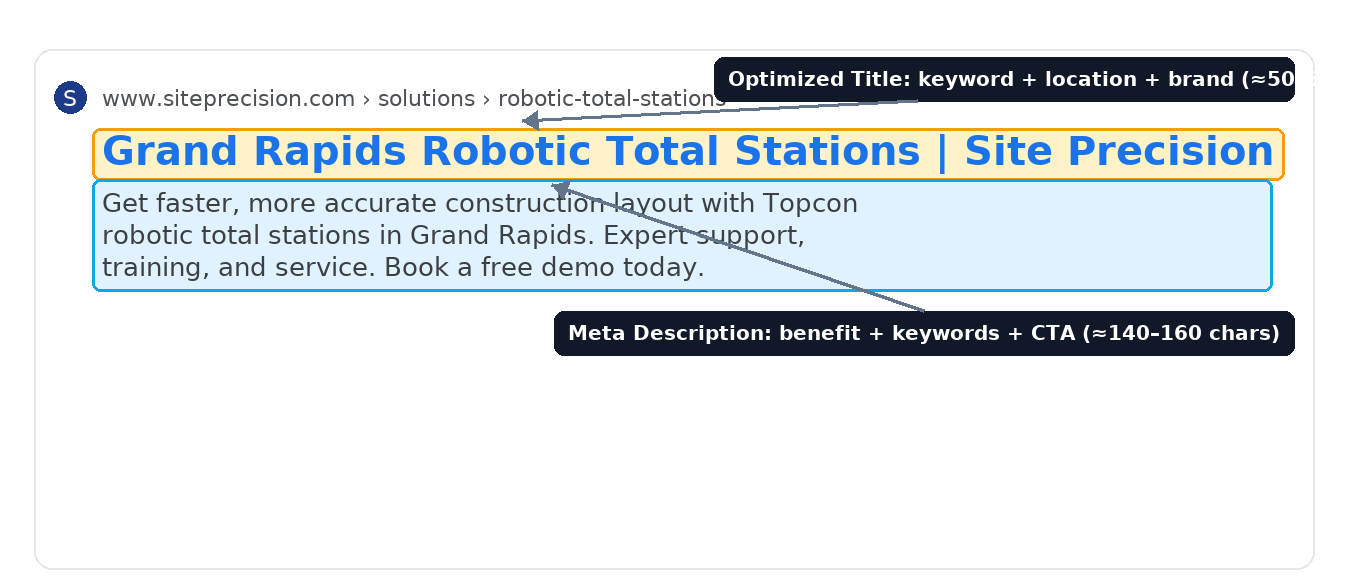
Audit your current site. Assign one keyword per page. Restructure titles, meta descriptions, headers, and URLs to reflect that focus.
If multiple pages target the same keyword, consolidate them. If a page has no clear keyword, either give it one or consider whether it needs to exist.

Why this matters for GEO and AI search
Key insight: The “one keyword per page” rule is now more important than ever. It serves both traditional SEO and Generative Engine Optimization (GEO).
In 2026, keywords matter for more than just Google’s traditional rankings. AI search tools, including ChatGPT, Perplexity, and Google AI Overviews, also pull from well-structured, keyword-focused pages when generating answers.
GEO (Generative Engine Optimization) means structuring your content so AI models can easily extract and cite your information. Pages with a clear, single-topic focus are more likely to be cited by AI because the content is unambiguous. The AI knows exactly what your page is about and can confidently reference it.
Think about it this way: when an AI tool needs to answer “how long does SEO take to work,” it looks for the page that most clearly and thoroughly answers that one question. A page that also tries to cover keyword research, link building, and content strategy will lose out to the focused page every time.
This means your keyword mapping exercise has doubled in value. Every page you optimize for one keyword is now optimized for both Google rankings and AI citations across multiple platforms.
Key Takeaways
Each page should target one main keyword.
This helps Google understand intent, which leads to better rankings.
It prevents keyword cannibalization across your own site.
Use supporting keywords naturally, but only one primary per page.
AI search tools prefer single-topic pages for citations.
Start by auditing your current site and remapping each page to one keyword.
FAQs
What is the difference between a primary keyword and a secondary keyword?
A primary keyword is the main phrase you want a page to rank for. It should appear in your title tag, H1, URL, and meta description. Secondary keywords are related terms and variations that support the primary keyword. They occur naturally throughout the content but are not the main focus. For example, if your primary keyword is ‘WordPress web design,’ secondary keywords might include ‘custom WordPress development’ or ‘WordPress website builder.’
How many keywords should a blog post target?
One primary keyword. Most successful blog posts rank for dozens or even hundreds of related terms, but that happens naturally when you write comprehensive content about one focused topic. Trying to intentionally target multiple primary keywords in one post dilutes your ranking potential for all of them.
Does keyword strategy still matter with AI search?
More than ever. AI search tools like ChatGPT, Perplexity, and Google AI Overviews need to understand what your page is about before they can cite it. Clear keyword focus makes your content easier for AI to parse, categorize, and reference. Pages with a single clear topic are cited more often than pages that try to cover everything.
What is keyword cannibalization?
Keyword cannibalization happens when multiple pages on your site target the same keyword. Instead of one strong page ranking well, Google splits the ranking signals across the competing pages, and none of them perform as well as they could. Fix this by consolidating the pages or giving each one a distinct primary keyword.
How do I find the right keyword for my business?
Start with what your customers actually search for. Use Google Keyword Planner (free) to see search volumes, check Google Search Console to see what queries already bring traffic, and use tools like Ahrefs or SEMRush for competitor analysis. Think about intent: are people searching to learn, compare, or buy? Match each page to the keyword that fits its purpose.